

Every October, designers around the world pull out their sketchbooks for Inktober, a month-long challenge originally started by artist Jake Parker. But in our world of architecture, that simple idea has evolved into something uniquely powerful: InktoberArchitecture.
This movement, created by Nathan Taylor (Building Envelope Consultant, artist, and founder of BuildingScape), has become a global celebration of sketching, design thinking, and the joy of putting ink to paper. In this episode of What the RFI?, I sat down with Nathan to talk about the creative spark behind the challenge, why sketching still matters in an AI-driven industry, and how architects can reconnect with the craft that started it all.
“There will always be something about analog and doing it by hand. There’s a connection between the hand, the eye, and the brain that helps you truly understand what you’re designing.” — Nathan Taylor
The Story Behind InktoberArchitecture
“InktoberArchitecture started as a way to get architects drawing again,” Nathan explains.
What began as a personal adaptation of Inktober’s daily prompts has now grown into an international community. Last year, participants from nine countries and nearly 500 architects took part, posting sketches tagged #InktoberArchitecture across LinkedIn and Instagram.
“It doesn’t matter if you use markers, pens, or a napkin — the goal is to share visual communication and inspire each other.”
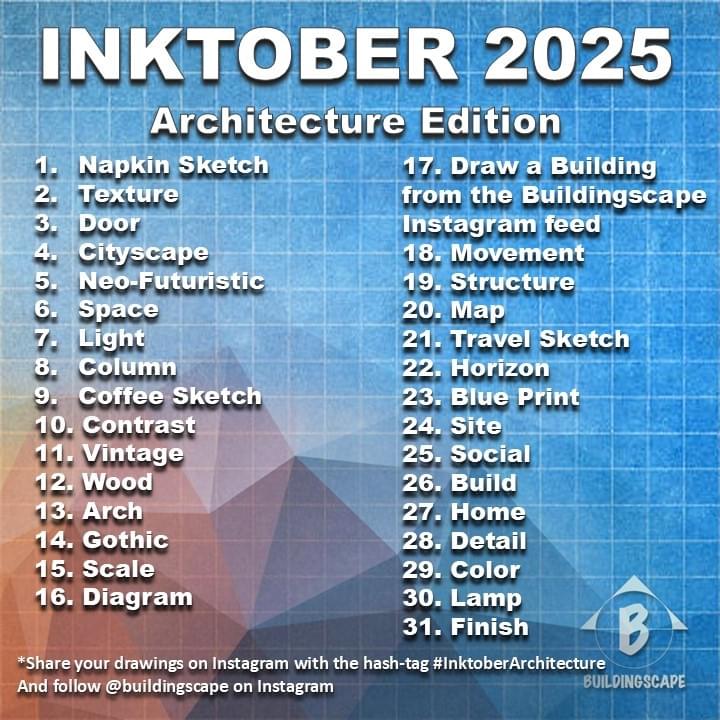
This year, the list of prompts ranges from “Napkin Sketch” to “Blueprint,” “Movement,” and “Finish.” Each word challenges architects to interpret it in their own way — no rules, no grades, no deadlines, just creativity.
“The best part is seeing the diversity of people’s creative thoughts. You give everyone the same word, and they all take it somewhere completely different.” — Nathan Taylor
Why Sketching Still Matters in the Digital Age
It’s easy to think that drawing has become obsolete in a world dominated by BIM, Revit, and AI-generated visualization. Yet Nathan argues the opposite: the act of drawing remains a fundamental part of how architects think, communicate, and problem-solve.
“There’s a direct connection when you draw by hand,” he says. “When you sketch a building, you’re literally tracing how water might run over the roof, how the facade works, how materials come together. It’s how you learn.”
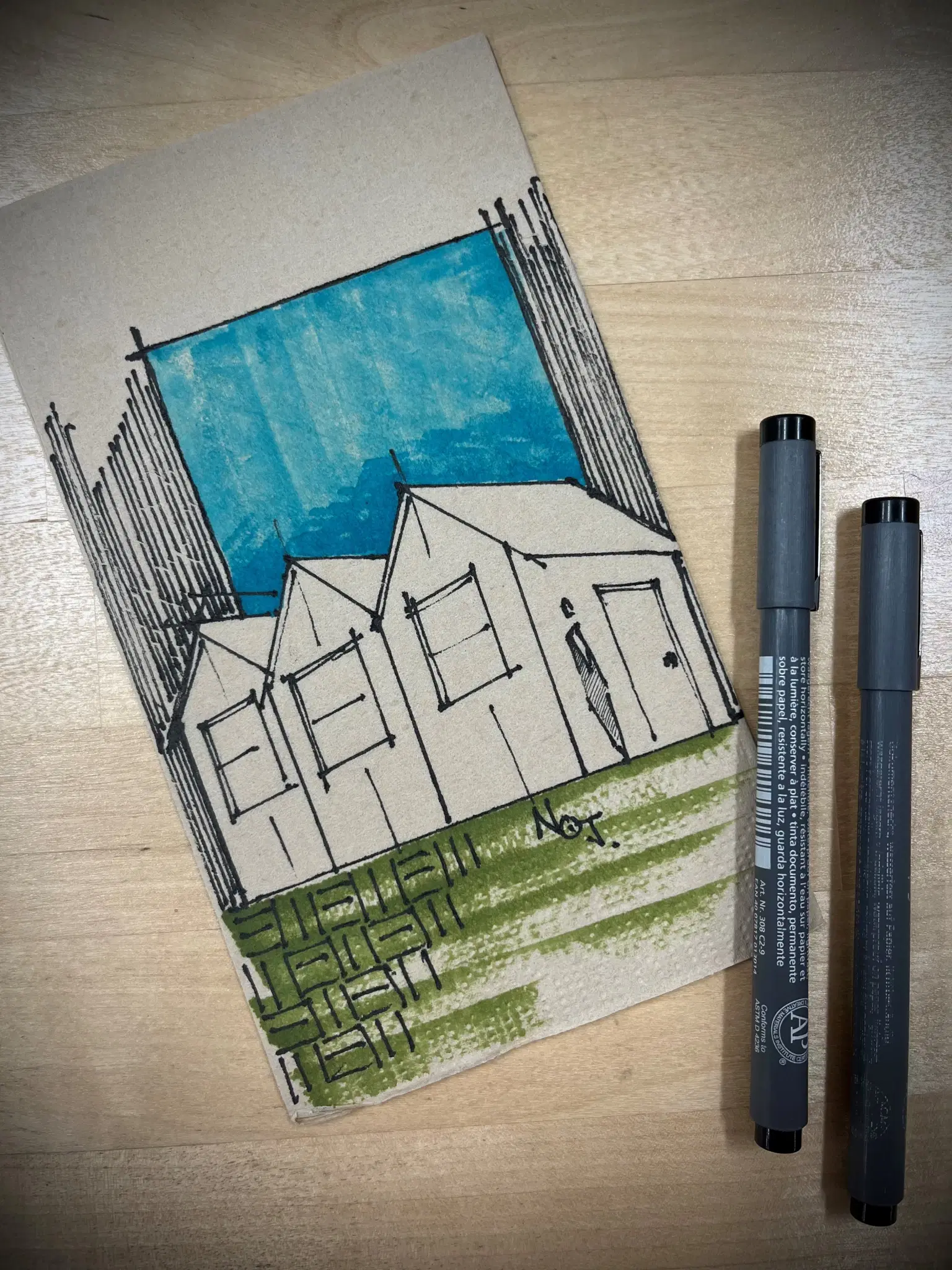
I couldn’t agree more. In Construction Administration, hand sketches often communicate faster and clearer than any 3D model or RFI thread. They build understanding in real-time, across the table, on the jobsite, between the architect and contractor.
As Nathan puts it:
“You might not have your laptop or Revit open on site, but you’ll always have a piece of paper. And when you can sketch an idea, language barriers disappear. Everyone understands a drawing.”
Sketching as a Communication Tool
We talked about those tense field moments — the ones where a problem emerges, trades are frustrated, and the clock is ticking. That’s where sketching can literally change the tone of the conversation.
“Pulling out a site plan and sketching over it shifts the focus from blame to solutions. Everyone leans in, looks at the same drawing, and starts solving the problem together.”
That ability to unify teams through visual problem-solving is what makes sketching more than just an artistic exercise — it’s a core leadership skill in Construction Administration.

Tools of the Trade
Nathan laughs when I ask about his go-to pen. “I’m a Micron guy,” he says, holding up a handful of fineliners. “But I’ll use anything — Sharpies, paint pens, even white ink on a brown napkin. The point is to break out of being too meticulous and just create.”
For digital sketchers, apps like Morpholio Trace can bridge the analog-digital gap. But even with the best tools, Nathan insists that nothing replaces the tactile feel of paper.
“With a sketchbook, you’re directly interfacing with what you’re creating. You’re not clicking a mouse; you’re building the line with your hand.”
Community, Culture, and Joy
Architects are no strangers to deadlines, RFIs, and long nights in studio. InktoberArchitecture reminds us that drawing can still be play.
“Most of us are overworked. Sketching is a creative release — a way to reconnect with why we fell in love with design in the first place.” — Nathan Taylor
The movement’s strength lies in its community. Firms pin sketches to office walls, parents sketch alongside their kids, and professionals around the world share their napkin doodles online. It’s a monthly reminder that architecture is as much about imagination as it is about precision.
How to Get Involved
Participating is simple:
Visit Nathan’s blog: BuildingScape.WordPress.com
Download the 2025 prompt list.
Sketch something every day (or whenever you can).
Post it using the hashtags #InktoberArchitecture and #BuildingScape.
Tag your peers — encourage your team, classmates, or firm to join in.
“You don’t need to be good at drawing; you just need to start. Every line builds confidence.” — Nathan Taylor
Final Thoughts
As architects, we spend our days turning lines into buildings, but sometimes the most meaningful lines are the ones we draw just for ourselves.
InktoberArchitecture is more than a creative challenge — it’s a reminder that design begins with curiosity, clarity, and connection.
So grab your sketchbook, roll out the trace, and draw something today.
It doesn’t need to be perfect. It just needs to start with a line.
Listen to the Full Episode
🎧 What the RFI? – Episode 36: InktoberArchitecture with Nathan Taylor
Available on Apple Podcasts, Spotify, and WhatTheRFI.com.
Follow the Movement
• InktoberArchitecture 2025 Post

Fan Mail: How to Get Into Construction Administration
How do you get into Construction Administration? In this special episode of What the RFI?, recorded while on vacation in Tofino, BC, I answer some fan mail from Richard—an experienced Architectural Technologist looking to make the jump into a full-time Construction Administration role. We talk about how experience in architectural technology, construction documents, RFIs, shop drawings and consultant coordination can become the foundation for a career in CA—and why you probably already know m...
Occupancy Inspections: What Building Inspectors Look For
Your building is nearly finished. The consultants have signed off. Integrated systems testing is complete. Everyone is talking about move-in day. Now the building inspector is coming. In Episode 50 of What the RFI?, we’re talking about one of the biggest milestones in Construction Administration: the occupancy inspection. What happens when the Authority Having Jurisdiction (AHJ) arrives on site? What is the building inspector actually looking for? Who should attend the inspection? And what ha...
CAN/ULC-S1001 Integrated Systems Testing — Getting Ready for Occupancy
What happens after the fire alarm goes off? Does the elevator recall? Do the doors release? Do the mechanical systems respond? Does the monitoring station receive the signal? In Episode 49 of What the RFI?, we continue our four-part Building Occupancy Series with a practical look at CAN/ULC-S1001 Integrated Systems Testing from the Construction Administrator’s perspective. We break down what S1001 testing is, how it differs from fire alarm verification, who needs to be involved, how to prepar...