


Concrete is the most widely used building material on Earth—and yet, it remains one of the biggest sources of miscommunication, rework, and RFIs on construction projects. In Episode 33 of What the RFI, host Matt Brennan is joined by Christopher Bennett (Tau Group) and Ryan Stoltz (Structures) to break down why concrete construction continues to challenge teams and what can be done to fix it.
This episode goes beyond just mix designs or curing methods—it’s about how specs, sustainability targets, and cross-team communication either set a project up for success or failure.
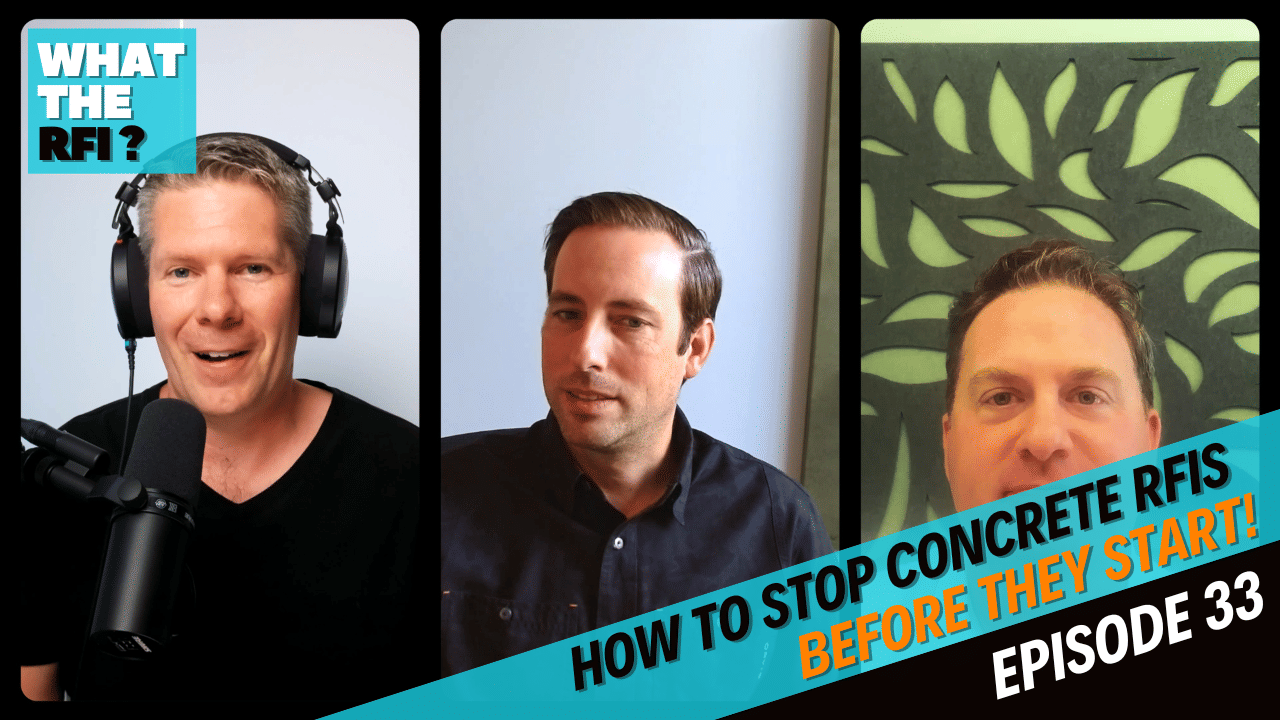
“Concrete is in every job.”
One of the earliest insights comes from Ryan Stoltz, who leads engineering at Structures. He puts it plainly: whether you’re building a school, a civic center, or a data hall, you’re dealing with concrete.
But with that ubiquity comes assumption, and that assumption is where many teams go wrong.
“We kept seeing ‘polished concrete’ on finish schedules,” said Ryan, “but no one could agree on what that actually meant. It was driving RFIs, change orders, and field conflicts.”
Specs were being copied and pasted without clarity, and expectations were being lost somewhere between design intent and execution.
From “Polished” to “Refined”: Rethinking Concrete Finishes
Christopher Bennett knows specs better than most. With a background in cryptologic linguistics and deep expertise in Division 03, Chris has spent years decoding how language drives construction outcomes—literally.
“We needed a new language for concrete that everyone could understand—designers, contractors, and owners,” he said.
That idea led to the Refined Concrete Finishing Specification, developed with the National Concrete Refining Institute. The goal: eliminate vague finish terms like “light polish” or “Class B smooth” and replace them with quantifiable field criteria like RA values, coefficient of friction, gloss levels, and scratch resistance.
“You can’t manage what you can’t measure,” Chris explained. “When you specify numbers, you’re giving the contractor something they can hit, and you’re protecting the owner from ambiguity.”
One Mix, Fewer Problems
A major success story came from the Kendrick Elementary School project. Instead of using multiple concrete mixes across site, slab, and finish zones, the team used a single mix design with a flexible performance profile.
It was a win across the board!
“We saved water, reduced cement content, and simplified submittals,” Ryan said. “Most importantly, we didn’t see the same back-and-forth RFIs we’d normally expect. Instead of four different suppliers and seven test breaks, we had one. And the field crews knew exactly what to expect.”
This approach reduced risk, improved coordination, and helped the project hit sustainability goals without impacting cost or performance.
Sustainability Doesn’t Have to Mean Premium Pricing
Chris was quick to call out one of the biggest myths around low-carbon concrete: that it always costs more.
“A lot of sustainable mix designs actually cost less. You’re removing cement, which is the most expensive and carbon-heavy component,” he said. “But it only works if your spec allows for it and the team understands what they’re using.”
What’s missing, they agreed, is often not a solution—but alignment. When architects, engineers, and suppliers aren’t talking early enough, opportunities for better performance and lower carbon footprints are missed.
Why Concrete RFIs Keep Showing Up
Despite decades of concrete use, RFIs in this category remain stubbornly common. Some of the biggest causes they identified:
Vague finish specs with no measurable outcome
Specs that don’t account for mass concrete behavior or curing needs
Mix designs that conflict with project sustainability targets
Training gaps among labor forces unfamiliar with low-carbon or alternate materials
Ownership issues—who’s responsible for thermal control, finish prep, or field testing?
RFIs, in many cases, are just the symptom. The disease is often unclear documents and missed conversations.
“Clarity is the new foundation.”
As Chris summed it up toward the end of the episode, construction administration isn’t just paperwork—it’s storytelling, expectation-setting, and translating performance goals into reality.
“Clarity is the new foundation,” he said. “If you get that right, everything else gets easier.” Ryan echoed the sentiment.
“We all need to understand the material we’re designing, specifying, and pouring,” he said. “And if we don’t? That’s where the RFIs start.”
Episode Takeaways
Write specs that use measurable field criteria, not vague descriptions
Start conversations about mix performance and finish expectations early
Don’t assume sustainability will add cost—understand how mix design can support budget goals
Train field teams in what to expect, especially when working with non-standard finishes
Use fewer mix designs when possible to simplify coordination and testing
Align early across architects, engineers, and contractors to prevent RFIs and change orders
Resources
Listen to Episode 33
You can listen to Concrete Clarity (Episode 33 of What the RFI) on Apple, Spotify, or wherever you get your podcasts.

CAN/ULC-S1001 Integrated Systems Testing — Getting Ready for Occupancy
What happens after the fire alarm goes off? Does the elevator recall? Do the doors release? Do the mechanical systems respond? Does the monitoring station receive the signal? In Episode 49 of What the RFI?, we continue our four-part Building Occupancy Series with a practical look at CAN/ULC-S1001 Integrated Systems Testing from the Construction Administrator’s perspective. We break down what S1001 testing is, how it differs from fire alarm verification, who needs to be involved, how to prepar...

50% Canada-U.S. Tariffs Hit Construction: What Happens Next?
Canada-U.S. tariffs are hitting construction, raising new questions about material costs, steel prices, procurement, contracts, and who ultimately pays when prices suddenly change. With new 50% U.S. tariffs affecting billions of dollars of Canadian goods and Canada preparing retaliatory measures, construction materials including steel, aluminum, lumber, cement, plywood, paint, and other building products are caught in the middle. In Episode 48 of What the RFI?, Matt Brennan looks beyond the p...
Construction Occupancy: How to Prepare for the Final Inspection
Your construction project is 99% complete. The walls are painted, the flooring is down, the lights are on and everyone is talking about move-in day. So you’re basically done, right? Not even close! Getting a building ready for occupancy requires months of preparation, testing, documentation and coordination between the contractor, consultants, owner and Authority Having Jurisdiction (AHJ). In Episode 47 of What the RFI?, Matt Brennan kicks off a four-part series on construction occupancy and ...