
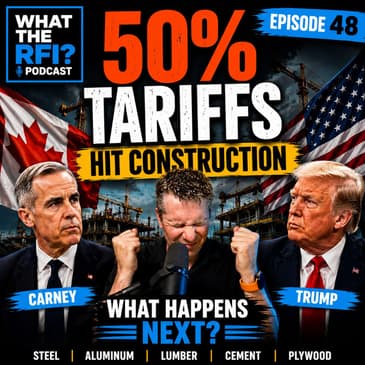
Canada-U.S. tariffs are hitting construction, raising new questions about material costs, steel prices, procurement, contracts, and who ultimately pays when prices suddenly change.
With new 50% U.S. tariffs affecting billions of dollars of Canadian goods and Canada preparing retaliatory measures, construction materials including steel, aluminum, lumber, cement, plywood, paint, and other building products are caught in the middle.
In Episode 48 of What the RFI?, Matt Brennan looks beyond the political headlines and asks what the latest Canada-U.S. trade dispute could actually mean for construction projects on both sides of the border.
Material pricing is already volatile. On a recent project, a U.S. steel detailer described steel pricing that had previously been around $1 per pound now exceeding $3.50 per pound. Tariffs aren’t necessarily responsible for that entire increase, but it’s a real-world example of how quickly construction pricing can change.
The bigger Construction Administration question is what happens when those increases reach a project that has already been tendered or is under construction.
Who carries the additional cost? What does the construction contract say about tariffs, duties, taxes, and material escalation? How should a tariff-related change be evaluated? What documentation should contractors provide? And could this uncertainty lead to larger contingencies, shorter quote-validity periods, earlier procurement, and more substitution requests?
Because tariffs might be negotiated in Ottawa and Washington, but eventually they can find their way into our tenders, procurement, RFIs, substitution requests, change orders, and construction budgets.
Chapters
- 00:00 — 50% Tariffs and Construction
- 01:36 — What Happened With Canada-U.S. Trade Talks?
- 03:20 — Construction Materials Affected by Tariffs
- 05:14 — Why Tariffs Matter to Construction
- 05:31 — Steel Prices: $1 to Over $3.50 Per Pound
- 09:35 — Why U.S. Construction Could Be Affected Too
- 12:58 — Construction Pricing and Tariff Uncertainty
- 16:04 — What Happens to Existing Construction Contracts?
- 16:47 — Proving Tariff-Related Construction Costs
- 19:40 — Get Ready for Substitution Requests
- 22:00 — What Construction Teams Should Do Now
- 23:42 — What Happens Next?
Recorded August 24, 2026.
The Canada-U.S. trade situation is developing quickly. Tariffs, counter-tariffs, and trade policies discussed in this episode reflect information available at the time of recording and may change.
🎙️ What the RFI? is a podcast about Construction Administration and the real-world challenges that happen between the drawings and the finished building.
Are tariffs already hitting your construction projects? Tell me what you’re seeing in the field.
Got an RFI for Matt? Send it here!
🎙️Website - WhattheRFI.com
🍏Apple Podcast - What the RFI?
🎧Spotify - What the RFI?
🎥YouTube - @WhatTheRFI
Well, tariffs are back. And this time we're not just talking about what might happen to construction. We're actually starting to see what is actually happening in construction. Over the weekend, if you haven't seen the news, but basically some big bombs were dropped and Canada, US, the trade negotiations, they fell apart. Unfortunately, they did. It sounded like they're really close, but it fell apart. And the new 50% US tariffs have taken effect on approximately $20 billion of worth of Canadian goods. And we're seeing construction products caught up in this. And this includes things like cement, plywood, paint, fiber cabling. And on top of that, the uncertainty, we've already been dealing with this around with steel, aluminum, copper, and the lumber. So and today, to make matters worse, President Trump went even further to announce that tariffs could increase to 50% to additional Canadian products, including steel, beginning January 1st, 2027. Meanwhile, Canada is preparing its own retaliatory against these tariffs, news to come tomorrow. So what does this all eventually mean if we're trying to build something? And the list goes on. Let's get into it. Welcome to What the RFI. I'm Matt Brennan, and this is the podcast all about CA. So what just happened? And first off, I'm recording this on Monday, August 24, 2026. And the actual time is 703 p.m. Hey, I've been reading the news over the weekend. We've all been seeing it come through. And really, what is going to happen next? Let's find out. And I'm saying this story is really changing daily, minute by minute, hour by hour. More news is being updated. There was supposed to be a press release tonight. It seemed like maybe it got postponed. I'm not sure. But the reality is things are changing very, very fast. So hold on. And if you haven't fallen, Canada and the United States have been negotiating towards a brand new trade agreement. I was hopeful that this was all going to get all wrapped up. And then we go back to some normal 2026. It'd be nice to have a normal 2026, but we haven't had that yet. And part of those negotiations, including some of the tariffs affecting Canadian steel, aluminum and automobiles entering the U.S., those were going to come to an end. They were going to come to an agreement, but they fell apart. Those negotiations fell apart. And the United States has now imposed a brand new 50% tariffs on this $20 billion of worth of Canadian goods that are being imported into the States. And we've already seen this in the construction of related products caught in the middle. Like I said, cement, plywood, paint, fiber cable has been kind of talked and brought up to the notion here. And along with the larger trade issues is we're already surrounding steel, aluminum, copper and lumber. It's been a challenging year. It's been a challenging year if you've tendered any projects pre tariffs and then are still going in during construction with tariffs. And now how is this going to change? I actually got a project that is going to tender on Friday. And I guess we're going to find out where this pricing is going to come in. The first thing I'm going to do is once we lock it in, once this project gets closed and we're awarded, we're going to say order everything you physically can and put it in warehouses because we don't want to we don't want to pay 50% on product and none of the trades do. But my heart goes out to some of these trades such as like the painters. Well, they can't buy their product in advance. So what are they supposed to do? Carry the 50%, maybe more, maybe 100%. Who knows? Hey, but getting back to the story here, Canada meanwhile has announced that they're going to retaliate dollar to dollars, whatever the US decides to pose on to Canada. Canada is just going to fire right back. And at the end of the day, this isn't helpful. This is not helpful for me. This is not helpful. You as a listener, it's not going to be helpful for the general contractor to the individual that to that painter to that sub that's wearing the steel. This is making a mess on both ends of the construction front. Hey, and with the expectation of these details from Canada re-italiating, you know, again, the news to come tomorrow, we might see this get implemented as of September 8th. Those are the dates that are being thrown around. It the story is not over here. It is continuing and it's not getting better. We're not even close to being done. This is just crazy. So why are we talking about this in a construction administration podcast? Right? Well, because eventually tariffs are going to show up in your project if they haven't already. OK, and we're seeing some crazy material pricing as is. Here's a real life example with pricing moving just so crazy over these years. I actually came from a friend who is in the US. He's a steel detailer. It's Adam. He's been on the show and everything. We had kind of an offline conversation about kind of where he was seeing the prices go and politics aside, it was just how are things going? And during that call, you know, pre tariffs, you've seen about a dollar per pound per linear foot of steel. OK, not bad, not bad. And today to more than three dollars and 50 cents per pound per linear foot, times are changing. I remember when we would go down to the I would cross over the border and things were cheap. It was like a third of the cost. And then the exchange from, you know, from, you know, from US to Canadian dollars in that respect. And it was still but it was still favorable. It was still cheaper. I was in Newport doing a little, you know, just myself going out for a surf trip. And, you know, it was almost dollar to dollar plus the exchange. Things have really changed on your guys's front. And I know it's not helping on your end because wages aren't going up. Salaries aren't going up. Right. Grocers are going up. Everything's just getting squeezed more and more. And these tariffs are not helping the cause. Right. Trade is a good thing. We do it back and forth. It's the way that you do business. Right. We have a lot of energy that we sell down to the States. And then, of course, there's a lot of commodities. Our steel goes down to you. And then, of course, the finally molded steel comes back up to Canada. So it's huge. So with these increases, it's just. It just sucks. Let's just put it that way. And and I want to be really clear right now that I'm not saying tariffs have caused this entire increase in material pricing is really complicated on its own. End of story. And there's a lot of factors affecting the steel price. The example I just gave. But when we're seeing increases like this, while the government is simultaneously fighting over tariffs and steel and now again, paint and lumber and everything, you start paying attention to what's going on because isn't just structural beams. It goes beyond that. It's miscellaneous metals, stairs, railings, joys, stacking, steel, studs, door frames, hardware, mechanical equipment, electrical equipment and countless manufactured products we can keep going here. OK, the outlets in your wall. There's a bit of steel in there, right, especially this fire right wall. Right. Everything's affected. Right. And this is even goes into your furniture that's getting put into the building. Take notice. Things are changing drastically. It's hard to tender jobs right now and be ready to review pricing that comes in and be ready for the amount of requests for extras later. And at the end of the day, we all want everyone to win. We want to build a great project together. We want the GC to do well. We want their subs to do well. We don't want to see anyone hurting in that sense or defiling. In companies I've had to review shop drawings because Millwork, that trade went under and I had to review another shop drawing and I wasn't getting the products that we wanted to because we just can't get it because the tariffs or something like this, things are affecting. It's happening in construction so rapidly, so steadily and unpredictable. Hey. And and now we're talking about things like cement, plywood paint as well. Well, pretty quickly, it's going to start touching a significant portion of the construction project. So if you were a budging, you know, X, just double it. That's where we're kind of heading towards this. And how do you how do you do that? How do you add a contingency for this where things you just can't control it? And this isn't just a Canadian problem. Hey, I'm from Canada, Canadian citizens, in that respect. But. Hey, I love my my neighbors in the south in that respect, guys, you know, I really do. I love coming out there. I love visiting your country and everything. I love I've got lots of friends out there and then, you know, in conversation. And I love working together. Again, all our suppliers are down in the US. It's it's it's a team effort on that front. Right. And and I think this is really important. This isn't kind of gets tariffs, therefore, can construction gets more expensive? It's not that it's much more complicated than that. And this is where it can affect construction on both sides of the border. And this is just straight up sucks, right? Where it comes is and kind of the United States have incredibly integrated supply chains, as we've kind of already talked about, right, from everything. I need your stuff, vice versa. I need your material. Right. It goes back and forth. Raw materials cross the border, as we kind of talked with the steel in that case. The components cross the border. The finished products again cross the board. Right. We just keep going back and forth, back and forth. And some products can cross the border multiple times before they actually arrive to the construction site. Not typically, but, you know, take lighting, for example, and see a lot of those tears where we've got, you know, our materials, raw materials going down to the States, it's lights are getting manufactured. Then they're coming back. And again, we're just seeing this bouncing back and forth. And prices are just going to have to go somewhere. Someone's got to pay for them. So again, at the end user, we're going to pay for them. OK. So. So an American contractor may be buying a Canadian material, but a Canadian contractor might be buying American equipment. An American manufacturer might be using a Canadian raw material. You get the point. You get the picture. That's just a few examples. The ripple effects start to happen in this real time moment. And Canada has significantly been a supplier of Canadian cement to the US, right? We we know it's eight percent of the general CO2 emissions, right? It's a it's a big deal. It's so heavy and it's expensive to transport. These all play into the game and you can't necessarily find we'll just get it somewhere else. It doesn't work like that. All right. It's not going to happen. When we dealt with tariffs, oh, goodness, like eight years ago, we're at the first round when President Trump was in office. We tried to source a lot of steel fabricated beams locally in Canada, and it was really tough. We give you the material, you guys mold it, bend it, do everything like that. And then it comes back over and then we build with it. It's tough, right? It's a joint effort. It's a team effort between both sides of the country. Okay. And. With both these markets close to the Canadian border. There's just really Canada versus American construction story here. You can't you can't happen, right? Both industries are incredibly interconnected. I want to just repeat that. Both industries are extremely intricately connected. And the biggest problem might be the uncertainty. I mean, for example, tomorrow's Tuesday, what's going to happen? Well, we're going to find out. And for construction, I think the biggest problem is actually is the uncertain. Like saying this, and I think how we build the projects, we design something today, it goes to tender and then a general contractor prices it, their subs price it, and the quotes are being pushed back and forth. The suppliers even come to the table with that. And we sign the contract tender is closed. We've signed an agreement. If we're doing a step some project, not a design build or anything like that. IPD, we're doing a step some. This is how it is. Six months later, 12 months later, maybe needs 18 months later. But hey, I'm going on like the six months. Probably prediction here. What prices do we carry? Really, what prices do we carry in this moment? Quotations coming back saying price invalid for 30 days. Yeah, try that again. Pricing for 14 days. No, we could just basically pricing subject to the to tariffs in effect of time delivery. We may see some of those contracts. And again, this isn't helpful from anyone's perspective, whether the architect be a constantly reviewing these requests for extras, the contractor getting the request for extras and fighting for their trades and then battling through legal terms of what's in the contract, all these items, all these items are coming into place. Right. And maybe one of those things on the quote, will say project pricing subject to material escalation. There's going to be some new language going into these contracts because we just can't keep up. How do we how do we protect the owner, the contractor and the sub? That's how it's coming down. And eventually someone's got to carry all the risk to the contractor. Is it the sub? Maybe it's the supplier, you know, it should be on them, should be on the owner and nobody wants these costs going to the menda story. Right. Again, we all want to live. We all have to feed our families. We've got the roof over our head. We don't want to be risking anything. We want to be doing a job well done. We want to come up with a profit and not respect. But what do we do? Okay. And they're probably going to put some contingency into these pricing. I don't know, but which means, again, that's in a certain uncertainty in itself. Okay. And that's where construction is just going to keep getting expensive. Right. It's not going to stop. Where is the breaking point? I don't know. Right. I don't think anyone knows. But again, contractors looking at their margins are going to see we've seen this with the condo industry. Right. How it's just totally slowed down. It stopped. People are starting. Closures are starting to happen, which really sucks. What does this mean for a housing bubble? I don't know. I don't know. And the existing contracts that we have in place are already starting to get interesting. Yeah. Well, and onto the construction administration side, what I mean by this is let's see. Your project is under construction. The project was tenured. Pricing come in. We've already talked about. But again, if a tariff is submitted today, who's going to pay? Right. I got one job that was tenured about six months ago. So we already had some tariffs in there for budget pricing. But now if they're going to go to 50 percent, what's going to happen? Right. We're going to have an honest conversation again. It's this is the reality of it. Right. And who's going to pay for this? OK, and most of all. Please show me the paperwork. Right. Before we entertain a request for extra, we've got to look at the paperwork. We got to go through that paper trail. And this is probably the biggest construction administration take away from all of this. Right. If somebody submits a chain saying there's 50 percent of tariffs. And so the product now costs 50 percent more. Hold on. Hold on. Show me. Show me. And because that's not necessarily how this works, not every product entering Canada or the United States will suddenly cost 50 percent more. Not an American product entering Canada will automatically be subject to that tariff. Right. It all depends on the product. Right. And this ties into the country of the region, the tariff classification numbers. These are we always request border certificates, the receipt at the border that is legit, not the broker. We want to see what was done and pay at the border with the official receipt. We're seeing so many variations of it and it's really hard to track. And you think this would be super simple. This should be really straightforward that the paperwork is night and day. You look at it, you review the classification code. Did it match? Was the tariff in place? All these things. ChatTPT is wonderful for helping you to kind of identify this and doing it. But you still got to go through the legwork and then fact check it because things are changing every day and you and again, you got to look at when the material was actually ordered. And this is where it gets so gray and it puts you as the architects reviewing these pricing in a real tough bind. And like I said, when we get these requests, I ask for the original quotation. Show me where it shows on the invoice where the owner and the project name is on it. Because there was a good skit from Tron Cleese who did it. It kind of kept running around the factory floor and they kept looking at new material. But it was the same material just getting restocked in the same as they went around the factory. And it's so true. It's funny, but that's what's happening in this application. This is what we're seeing in this moment. We got to cover a bus. We've got to protect our owners and a story. Why do we have to do it? It's because the two governments are going back and forth. And it'd be nice if we could just come to a fair and reasonable conclusion with these tariffs and be done with it and go on with 2026. Please. I really would like to just see that. OK, and we can't when we get these bills, we can't just see, you know, tariffs, 150K. We've got to go into the details. You've got to do your homework. That's not enough. You've got to do it. So it's just making our jobs on the CA front just that much more difficult. It's not like we're looking for stuff to do. It is what it is. And maybe get ready for substitution requests. Maybe that might happen, right? You know, given where some of these products are coming from, you may just have to try and source something locally. And hopefully there's not a tariff on it. But I tell you, you're going to be able to see that because the reality is if the material is coming from Canada down to the US, that's different. I think where things may change, if Canada changes the course of its trading and starts trading with other countries and other continents. That's where it may be the benefits. I don't know where this is all coming at. Right. Keep in mind with substitute changes. Well, first of all, you've heard me on the show. I hate alternates. So let's just get that out of the way. If you start changing air handling units for something that you can get, well, breaker size changes, right? All this start effect. So be careful that that's one thing. Lead times are going to be a different role into this. Is it going to start changing projects? Again, I'm always harping on my contractors. Please order as soon as possible. Order these doors or the firelight glass. I don't want to deal with this on an occupancy. Very important. OK, and by switching to a US Canadian product, vice versa, maybe it's going to be helpful. I think we're going to be creative with our design being ready to flexible. I think in our specs, note three, supply approved manufacturers and products. Right. That's probably going to be a better bet to help us out to give price fairly. If we start so sourcing products, well, a, they're going to jack up the price. That's given. But two, it's just I don't know if we can start to play that game and start putting more products in there. Maybe we're going to get more competitive pricing and at least gives us the opportunity to expect alternates. OK, and. But again, keep in mind again, I hate alternates, but cheaper doesn't automatically mean equivalent, right? It doesn't mean in that case. So we still have to review it. It comes in. It doesn't meet code, warranty, compliance, appearance, maintenance, lead times. All these things are really important. So this is the challenge that we're going to face in our construction administration. And because someone's saving twenty thousand, well, it creates forty thousand dollar problems. I hate alternates. So what we should what should we be doing right now? Hey, what should we be doing in this moment? Should architects, engineers, contractors, or is actually be doing in this case? Well, I'd be watching four things pricing, OK, especially the steel, loom, copper, lumber, cement, everything has been already, you know, kind of talked on the show, what we're seeing in the news procurement, where are the products coming from? Maybe we're going to start putting in our specs and needs to come from the US needs come from US. Depends where you sit on the border, where your project is. And maybe again, maybe from states to state, is it going to change? I don't think so, because again, it's based on the country, not the state. Hey, and your contract. Keep in mind understanding who actually carries the risk of these tariffs and the materials and the escalation that comes from it. Don't wait until the change order arrives to start reading that clause. You don't want to be in that case. So if you're in the moment of putting a tender document, a documentation together, yeah, this is a good time to go into those details and really hone into what it says in the language. Be very cautious of it. Documentation. OK, and I can't emphasize this enough, guys. Document the pricing, document the dates, document the supplier correspondence, everything that you need to basically ensure that this gets processed in the proper right fashion way. And from the contractor, please get all those documentation before you submit it to us. That's key. OK, because I never want to hear why did this cost us another two hundred thousand dollars. We want to be able to answer that question with integrity, with the documentation, with the data, no emotions, just focusing on the data at hand and being prepared for that. OK, so in closing, this story is moving very fast, right? I bet you the story is already updated by the time that you're starting to watch this right now, it's probably changed yet again. And there's another new breaking news. I don't know. Hopefully, hopefully you can watch this and get some insight into that. I'm recording this Monday night. I'm going to post it right away to YouTube. And, you know, Canada expects to announce some more details in response to moral. What are they going to do? I don't know. How is this going to change? And like I said, by the time you actually start watching this, something might have already changed to it, so but the bigger construction story isn't going away. It's here. It's staying. Terrace might be negotiations in Ottawa and Washington at the moment, but eventually they're going to make it away into our tenders, our fines, substitution requests, change orders and ultimately. Our construction budgets. And that's why everyone working in construction on both sides of the border, both sides. I want to emphasize that should be paying attention. Right. I'll continue to follow the story and we'll start to see the actual impacts of the construction. We'll keep it on the podcast. We'll keep it light. And again, it's not a political show and any kind of things, but this is the reality we're in. This is the state of our our world that we're in right now. And the other day, it's all going to come back to the construction value, the budget, the dollars. And can we actually finish some of these projects? We'll see. I wish I had that crystal ball to tell you guys. But anyways, stay locked to the show, like and subscribe and all that. And keep the RFIs moving, guys. And last but not least, architects keep designing and contractors keep making those blueprints into reality. We'll see on the next one.