
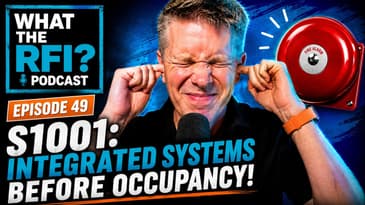
In Episode 49 of What the RFI?, we break down CAN/ULC-S1001 Integrated Systems Testing from the Construction Administrator’s perspective — what S1001 testing is, how it differs from fire alarm verification, who is responsible, what happens on testing day, and how integrated systems testing can affect your occupancy permit.
A fire alarm can work perfectly on its own, but what happens to everything else when that alarm activates?
Does the elevator recall?
Do the doors unlock?
Do magnetic hold-opens release?
Does the Building Automation System (BAS) respond?
Do fire and smoke dampers operate?
Does the monitoring company receive the correct signal?
That’s where CAN/ULC-S1001 Integrated Systems Testing comes in.
In this episode, we cover:
• What CAN/ULC-S1001 Integrated Systems Testing is
• S1001 testing vs. fire alarm verification
• How integrated fire and life-safety systems work together
• Who is responsible for coordinating S1001 testing
• Who needs to be involved on testing day
• The S1001 testing plan and checklist
• Why individual systems should be operational before integrated testing
• Coordinating contractors, consultants and technicians
• What actually happens during S1001 testing
• Common failures and deficiencies
• Retesting and documenting deficiencies
• The final S1001 report and its role in building occupancy
One of the biggest takeaways:
S1001 testing is not commissioning.
Individual systems should already be operational before integrated testing begins. S1001 is where the project demonstrates that the building’s interconnected fire protection and life-safety systems respond correctly together.
And when something doesn’t work, having the right contractor or technician on site can be the difference between a quick programming change and having to bring the entire testing team back another day.
This episode is Part 2 of the What the RFI? Occupancy Series, following our episode on Occupancy Preparation. Next, we continue toward the occupancy permit with the Authority Having Jurisdiction (AHJ) occupancy inspection.
🔥 START WITH PART 1 — OCCUPANCY PREP
Before S1001 testing begins, there is a lot that needs to happen to get a construction project ready for occupancy. In Part 1, we cover the testing, certificates, Letters of Assurance, consultant sign-offs and documentation that need to come together before the AHJ arrives.
▶️ Watch Episode 47 — Building Occupancy Preparation:
https://youtu.be/NflfD6lh0Gs
If you work in Construction Administration, architecture, engineering, construction management, commissioning, fire protection, building operations or the construction industry, this episode provides a practical look at one of the major testing milestones leading toward building occupancy.
Subscribe to What the RFI? for practical Construction Administration education covering RFIs, submittals, site instructions, change management, field reviews, occupancy, project closeout and the realities of administering construction contracts.
CHAPTERS
00:00 Fire Alarm Test — Does Everything Work?
00:39 S1001 Integrated Systems Testing
02:21 What Is CAN/ULC-S1001?
03:56 How Integrated Life-Safety Systems Work
05:41 S1001 vs. Fire Alarm Verification
07:09 Who Is Responsible for S1001 Testing?
10:34 The S1001 Testing Plan & Checklist
11:19 Before Testing Day — Don’t Use S1001 for Commissioning
12:45 Coordinate the Right People
15:31 S1001 Testing Day
19:30 Expect Something to Fail
21:29 Document Deficiencies & Retesting
22:40 Final S1001 Report for Occupancy
23:44 Construction Administrator Takeaways
25:17 S1001 Complete — What’s Next?
#S1001 #ConstructionAdministration #BuildingOccupancy
What the RFI? — The Construction Administration Podcast
Practical guidance for architects, engineers, consultants, contractors, owners, and project managers navigating construction administration.