
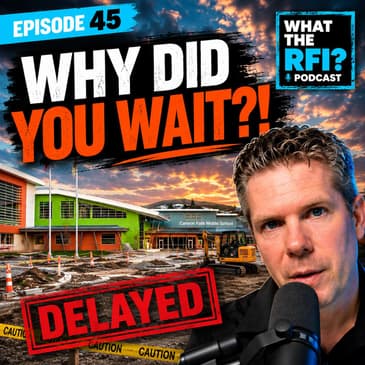
You have 24 months to build a school… yet somehow every deficiency, training session, closeout document, hardware adjustment and commissioning issue seems to appear in the final two weeks before occupancy.
Why?
In this episode of What the RFI?, Matt talks about procrastination in construction and why the final stretch before occupancy can become absolute chaos.
Using two school projects currently approaching occupancy, Matt shares some of the challenges from the past week—from fire alarm verification and elevator commissioning to door hardware, long-lead items, O&M manuals and owner training.
But this isn’t about blaming contractors. Architects, consultants, owners, suppliers and subcontractors all procrastinate. The problem comes when dozens of small things that could have been dealt with months ago suddenly become urgent at the same time.
We also get into the 90% complete trap, why construction project closeout needs to start months before occupancy, and the real cost of waiting until the last minute.
Because procrastination isn’t free.
Somebody always pays—with money, time, or both.
Chapters
- 00:00 Why Does Everything Happen Before Occupancy?
- 00:31 Welcome to Occupancy Season
- 02:59 Real-World Construction Closeout Problems
- 06:21 When Small Delays Put Occupancy at Risk
- 09:13 Why Do We Procrastinate?
- 11:38 The 90% Complete Trap
- 12:50 Start Project Closeout Four Months Early
- 15:24 Long-Lead Items, Commissioning & Training
- 17:21 The Real Cost of Construction Delays
- 19:23 Procrastination Isn’t Free
- 22:11 Accountability & the Final Takeaway
Whether you’re an architect, engineer, contractor, construction administrator or project manager, the takeaway is simple:
Closeout doesn’t start when construction ends. It starts months before occupancy.
Got an RFI for Matt? Send it here!
🎙️Website - WhattheRFI.com
🍏Apple Podcast - What the RFI?
🎧Spotify - What the RFI?
🎥YouTube - @WhatTheRFI
[00:00:00] You have 24 months to complete a school. Yet somehow every deficiency, every closeout document, every hardware adjustment, every ceiling tile replacement, every commission issue, every landscape deficiency, all magically appears during the final two weeks before occupancy. Why? Well, let's get into it.
[00:00:26] Welcome to What the RFI. I'm Matt Brennan, and this is the podcast all about CA. So this week, this month has been extremely busy and or should I just say it's been occupancy season. With schools, the reality is we like to get these schools open before September. And of course, based on the construction schedule, we always kind of have them target before the summer actually starts or the final move in starts in at the, you know, kind of the June when the
[00:00:55] before the teachers leave that they can move all their stuff into this new school and get all settled in and they can go enjoy their vacation because it's really hard to get them involved during the summer because they're on, they're on, they're on our holidays essentially, right? So this has been the month of August is known as occupancy season, okay? And it's this, this last few weeks has really got me thinking and basically one word stands out, procrastination.
[00:01:23] And we're going to dive into like how I'm seeing this here in this, this episode. And just being very clear, today's episode is not about pointing the fingers, including architects, consultants, even owners, sometimes even suppliers, right? But it's more how things over time, if you're not following up on items, you're not being, you know, proactive in a sense, they start to add up.
[00:01:52] And if we procrastinate them, they turn into bigger problems. And then they turn into really big problems when we come into the reality of occupancy and all the requirements that take place to that, okay? And I'm going to share a couple of real life stories from this last week, how I've seen everything come into play. And, you know, it just, it perfectly illustrates how small delays, like I said, we create the snowball effect.
[00:02:18] And this episode acts as a bit of a teaser to what I'm working on the side is basically we're going to try to put together possibly two, maybe even three part project closeout. So many items go into this. We've got checklists that we follow for each job, and it's really important.
[00:02:37] And we'll touch on about a little bit throughout this episode, but this is more, it's not a rant, but it's more, what can we do better to avoid the stress that comes from, you know, procrastinating, getting items in. So let me just set the scene here. So like I said, I've got two schools that are in the process of closing out. And for school number one, we're trying to basically gear up our S-1000 on one testing.
[00:03:04] Well, what this is in the province of British Columbia, and I'm sure you've got this similar states, is the local AHJs mandate a professional go out and do a full life safety testing. Prior to this, we would normally, as architects, we would do this on our own and sign off on it. Well, there's been a change in the billing code, been changing the local authorities where they mandate a specialized consultant to go out this and just double check and sign their piece of paper off.
[00:03:31] So it takes a lot of the responsibility of us, like still our responsibility, but it's taking a lot of the requirements off of us and putting it into this consultant's hand and they're coordinating it. But we're still recording it. Anyways, they do a fantastic job when out there. But before all this happens, there's a number of other items that need to take place.
[00:03:50] And, you know, before life safety happens, before this 1001 testing happens, you know, we need the door hardware to be acting properly, especially if it ties into the fire alarm integrated testing systems. Okay, it's really important to that. And I love when I get calls from the, you know, the contractor inquiring if we should be changing certain type of hardware out from accessibility. And I'm thinking, we're going for this testing in a week or so.
[00:04:18] Why am I getting this question asked today? I would have been happy to address this months ago when we could easily get that hardware out, etc. Okay. One thing I'm finding out that elevator commissioning is still overdue. That ties into the S-10001. It's not going to, the S-10001 testing will not pass if that elevator hasn't been fully commissioned. And it's not just by flicking a breaker and saying it's commissioned. No, they actually put weights on it for, you know, 48 hours, right?
[00:04:46] To make sure it doesn't deflect or change in its elevation. There's a whole bunch of testing with it in results of, again, this S-10001 in case of a fire, what would happen? Okay. Also, when we're having false alarms constantly go off in the evenings and costing the owner lots of money, these shouldn't be happening. These are, the system should be rock solid between the new and the old. We're at the end of the finish line, right? Which is theory. And we're still having outstanding reports.
[00:05:16] And a couple of tips we'll dive in later. But I like to meet with a contractor before all this just to ensure that we've got all our schedules. And then I can go out to my consultants and get their schedules for that final sign-off. We can get the city involved and getting them ready to queue up and come to this, basically this request for occupancy. But we can't do any of this occupancy.
[00:05:39] And we can't release schedules until we have all our schedule SBs, SCs for, you know, the glazing, for the cladding, for the guardrails. You know, basically this engineer saying this is acceptable to withstand a certain amount of load, right? All these things are important. And if we're getting these on the day of, it's a nightmare, right? And it doesn't have to be like that, okay? And just one delayed item after it is just affecting everything else.
[00:06:08] Hence, like they said, the snowball, okay? And the building was essentially finished, but the project wasn't ready for occupancy. School number two, okay? So we're waiting on for our fire alarm verification. That's one thing. We're waiting still on that elevator certificate. Where the school is, we have, because we're doing a phase occupancy, we need a specialized fire lane paved. Well, we don't have that.
[00:06:37] That's coming up till the last little bit. Again, all these are tying into the same thing in terms of occupancy. If we don't have a fire lane, we're not getting our occupancies. Why are we even having this conversation? Given the type of the site here, and because it's a phase occupancy, we've got some power poles in the right location, right in our main area that have to be removed. The building is now commissioned, but we've got to decommission these existing poles. Well, if we can't do that, the fire lane starts to get complicated.
[00:07:06] And on top of that, when they're ready to pull this out, they realize that it's not just TELUS as a communication provider, but there's also Rogers on the same pole. So now we've got to get in touch with them. It's just one thing after another of how things can go sideways really fast if you're not on top of it. We have some door hardware last minute changes as well. One was on us where we realized it was an exit from an outdoor patio.
[00:07:35] So again, if someone's trapped on there, we had to change it. Thankfully, that was an easy hardware fix that we could just quickly swap out with a different type of door hardware. Very simple to get in, but some hardware is not that simple to get into a timely fashion. Okay. And then we've got some door hardware wasn't installed as per drawings, as per specs. And now we're reviewing it at the last minute with the contractor. Thankfully, it was just an easy adjustment that they could fix it up.
[00:08:02] O&M documentation, not required for Occamacy, but it's nice to get this out of the way. Just get this and issue it and away we go. And at the end of the day, just everyone is chasing everyone, right? It's not a fun approach, right? So nothing here was a surprise. These were known items months ago. And that says it all right there. So transition into this. This is where it got me thinking.
[00:08:33] This isn't really an Occamacy problem. It's a procrastination problem. I'll let you be the judge. You know, shoot me a note, drop it in the comments, right? Somewhere along the way, we convince ourselves that closeout begins when construction is finished. Well, hang on. No, it doesn't. It kind of works tandem, side by side and together at one. Closeout begins months before the Occamacy. Okay.
[00:09:00] And here's two examples that we can relate to. We can laugh about, but we can apply it to these same scenarios. So example one, we treat Occamacy like New Year's Eve, right? We have the entire year to prepare and somehow we're making the resolutions at 1158. No, not important, but I like making my resolutions and I do like to stick to them.
[00:09:26] But I like thinking about them as we kind of keep going back and reflecting. Example number two. Construction procrastinations like waiting until your gas light comes on before you start looking for the gas station. Sure, you're probably going to make it to the gas station, but it could be a really stressful drive. I've ran out of gas once or twice in my life. It's never fun. One was just totally oblivious to it.
[00:09:54] And there was a time where I thought I wasn't going to make it. I certainly was clicking on my, checking on my dominer. I was checking at the local gas station, look at the kilometers and think it's going to be tight. And I'm sure we're going to be, you know, driving on those fumes. It's not fun. If I just was, you know, proactive before, you know, checking on to these things, it'd be no issue. The timing to fill up the gas in, you know, in a desperate scenario or not, it doesn't matter. It takes the same amount of time. So, but why didn't we apply it earlier? Would have made more sense.
[00:10:24] So why do we even do this to ourselves, right? It's not just on construction. It's not just on drawings. It's everything. One, we're human beings. We love procrastination for some reason, okay? It's just human nature. Hey, why am I recording this show late Sunday afternoon here for you guys when I should have did it on Friday? But you know what? I decided to go camping and jump in the lake before doing this. You know, do I regret it?
[00:10:52] No, it just made more sense. But we just, yeah, we procrastinate. How many little projects inside your home that are still outstanding because you just can't finish it, right? Those little things. It's just procrastination, okay? We always think we have more time. We really do. We totally underestimate it. I'm guilty of this. Oh yeah, that project will just take me, you know, it'll take me 10 minutes. Oh, no, it took me two hours, right? It depends on what it is.
[00:11:22] We just lose sight of focus of that, okay? And small tasks, sometimes they just don't feel urgent. But then suddenly, everything becomes urgent. And this is where we fall into the 90% trap, okay? The 90% complete trap is everyone thinks we're done, okay? But that last 10% is the hardest. It really is, okay?
[00:11:51] Hundreds of little items. Sometimes this just goes into the bigger picture. And like I was kind of alluding a minute ago about your own personal renovation projects. Man, like getting in there, being excited, going to get the material, getting it at home, starting to cut that crown molding, starting to paint it up, looking great. Hey, it's done. Wow, that looks fantastic. Oh, I got to dap the holes. I got, you know, I got to wood fill the corners here. Oh, now I got sand. And I got to paint it up.
[00:12:21] That is the hardest part, I find. Sometimes it's been just that one little piece of trim that I got to put as the closer strip on the wood flooring that you spend hours. But that one piece has just taken the longest and the hardest time. And it's that 10% that can really kill you when it comes to the end of the project, right? So needless to say, I've been there, been done that. I'm sure you've done it as well.
[00:12:48] So going forward, there's a few things that I'm changing personally and kind of implementing with our firm and how we run out these closeouts is four months before Occupacy. Now that we kind of do this kind of a month or two months, and I thought two months was an ample amount of time, but I'm going to change it. We're going to move the goalpost here and go four months before Occupacy. So if we want to go for Occupacy on August 1st, back date at four months, and that's when
[00:13:16] you should be having those serious conversations. That's when you should be issuing out your closeout checklist. And not just saying, oh, here's our list and we'll talk later. Again, it's not going to help us in any given moment. But put in the calendar, have monthly meetings about this and review it. Um, review it, you know, set a time, put in the calendar, get the right, um, typically you and the contractor in there and start going through that, that closeout list.
[00:13:43] And again, teaser alert, we're going to talk about this in the coming, uh, episode as well and how we do it. Okay. And hold the, the contractor accountable to the dates, hold yourself accountable to dates. If there's anything that you need, you got to be on top of it. If there's something that the consultant needs that they're relying on, again, moving those telephone poles or those, uh, power poles. Is there something that they need to do? Make an accountability chart to who needs to do what and pretend Occamacy is going in a month, yet you've got three extra months to spare with this.
[00:14:12] There's a lot of power of kind of changing that and change that perspective on this. And at the end of the day, don't allow procrastination to happen in this given moment. Okay. And like I said, bring your consultants early into this, this discussion point as needed, right? Their schedules aren't needed right at the beginning, but we should be able to do that. We should be getting these closeout certification documents. We should be getting these scheduled S Bs, SCs, making sure everyone's happy with them.
[00:14:39] Hey, the engineer saying this guardrail, they didn't sign off on this. Structural engineers are not happy. Great time to get in and, um, have those conversations early. So because it's an easy fix, um, if they take three, four days to respond, who cares? Because you still got four months to work with here versus I'm trying to go for Occamacy tomorrow. Oh, by the way, someone's going on holidays. It's never a good time. Okay. So just keep it like that.
[00:15:05] We don't want to have any surprises with this and closeout doesn't start when the consultants and closeout starts with, you know, months before the Occamacy, right? So, or within construction, it's like we kind of already said. Okay. And this brings me up into the next topic of long lead items, right? The long lead items are such as like your fire rated glass. Too many times I've seen this show up the day of Occamacy and they've quickly installed that
[00:15:35] fire light glass before the local AHJ authority comes on there and reviews it. Cause we won't let Occamacy slide without having that fire rated glass. Sometimes it's ties into an alternate solution or anything like that. So these are, you know, just a couple of long, um, items. No doors, door hardware, as we kind of already talked about. Typically you can't just get this overnight. All right. We've got a special door in one of the schools that is a fire rated flame frame.
[00:16:01] And it's been ordered for months and it's just been stuck in shipping. Thankfully, it actually just arrived last week. Fantastic. But this is stuff that you can't just go down to Rona, Home Depot and pick up that, that individual item. It's not going to happen, right? It's very specialized controls, commissioning, um, owner and facility staff training. Again, we're in summer. Everyone's on holidays. Most of them you're trying to schedule that date to work.
[00:16:31] You're certainly not going to do it in September when the school's open and when everyone's frantically for those first days. How, you know, we've got to be proactive with this at the same time, it all ties into the, you know, the, the sequence of events that you got to have the, the commissioning done, and then you can train the staff on actually what's out there. Ideally that's in the perfect scenario. Okay. Um, and your operations, uh, owner's manuals. Ideally, let's not drag this on beyond the occupancy of the project.
[00:17:00] Let's try and wrap these up before. And there's no reason why you, you know, we can't get these items done and order early schedule early. Just don't wait. Right. Let's put the focus on getting this done together as a team. It is a team effort. Okay. And this is where it ties into the cost of waiting. And what I mean by that is if we're all frantically trying to get this done, whether it's the contractor,
[00:17:28] the subtrades, the architect kind of scrambling put together, OT is a costly item, right? It's not needed. It costs, it's just, yeah, it's just, it's overtime. What do you expect? Okay. Um, and that typically results into week weekend work. And again, who wants to work on the weekend during a beautiful summer, right? You know, you want to be out at the lake. You want to be doing whatever you, you know, that you've got your holidays. You don't want to cancel and update your holidays.
[00:17:53] So again, this is just an, the reality of a cost to this, um, expedited shipping, right? Shipping costs rise. Um, we've got custom, sometimes stuff's coming over the borders and that kind of stuff. That all plays into an extra cost, especially if they order something. Now we've got tariffs on it versus if it was ordered two years ago or a year ago, their tariffs weren't in effect at that time. So there's a cost to that by itself. Premium pricing. Hey, you need it now. Supply demand. True. This is what it's going to cost you.
[00:18:22] I can pull it from another job, but you're going to have to pay on top of that. And the owner loses confidence in your construction firm, right? Who loses confidence in the architect of not running the show. It was very important. This goes into long standing relationships. We've talked about this many times on the show. And, you know, consultants, architects become firefighters, right? I do that enough as it is. I don't need to do it for a project where I know what to expect when it's coming to an end, right?
[00:18:50] And like I said, being a broken record here, it's hard enough when everyone's on holidays. It really is. It sucks. I really don't like it. Okay. And just everyone is stressed, right? It's just not good. I like to go home at five o'clock, call it a day, right? That's the reality of it, right? But sometimes this starts to, when these items aren't done, you may be spending that extra few hours just to make sure that it's all coming together. Okay.
[00:19:18] Needless to say, procrastination isn't free. Period. And somebody always pays either with money or worth their time or both. So in closing here, okay, don't blame it on your sub trade, right? I've heard that too, where contractors say, it was my sub trade. Well, that's fair enough. Maybe they're not doing the job. But again, we're a team when it comes to this, okay?
[00:19:47] As the general contractor, the contract is between the GC and the owner, okay? Um, if a sub trade is not delivering, right? If that is ultimately the problem on some of these little things, um, get on the phone with them, right? The contractor should be getting on the phone. And I know some of them do it daily and fantastic. We don't see that. So we can't see what's going on in that, I think. But if you're a contractor listening to this, ask and call your architect saying, I need a
[00:20:17] letter from you saying you have a notice of concern that we're not going to meet this. That little piece of paper will give the GC that power to push their sub trains. We've done this in the past where this school had a tight timeline. It was due in 18 months, very aggressive. And we had liquidity damages on it on the contract. Every day that they didn't finish it, it was $3,000 owed to the owner. So really serious numbers here.
[00:20:46] And nobody wants to pull that card, but we had that in the specifications, okay? And one of the things was we needed bodies on site. We needed to see that progress. So we issued a letter of notice of concern to the general contractor, which he took his ammunition and he blasted out to all his trades saying, this is serious. We're going to dock, um, hours. We're going to dock pay from you. We're going to hold back. Let's all get this together and move on and get this job done, right? And crack the champagne.
[00:21:20] Like I said, just gives the GC ammunition to work with and get going. And we are humans here. Hey, I'm human. You're human. Things slip through the cracks. And there's processes out there, right? By again, um, putting stuff in the calendar, having a detailed checklist. Those will help. But even on the best processes, things still slip through the cracks. And when they do, that's where, you know, one thing leads to another. Okay.
[00:21:48] But the positive here, all right? Delays can be avoided if carefully planned and executed on some of the following kick-ass processes we just talked about. It really pays out when you are proactive. When you put stuff in your calendar, you get the right people in the right room. You have an agenda before you get into that room. You work it out, set deadlines.
[00:22:15] At that point, hold people accountable and then do your check-ins, right? That's what I think it is. And again, saying this for the third time on the show today, closeout doesn't start when construction ends. It starts, um, it starts months before the occupancy. And I think if you can narrow down that, build your foundation off of that, you'll be good in that sense. Okay.
[00:22:43] Because if you're waiting until August to think about occupancy, you're already behind. Okay. And remember how I started this episode? You have 24 months to build a school. Don't spend the 23 months of them. Convince yourself that you still have plenty of time. Okay. Be proactive. Don't procrastinate. And the job will come together in a nice, beautiful fashion.
[00:23:14] Again, we'll talk more about closeout in the future episodes. But in the meantime, architects keep designing. Contractors keep making those blueprints a reality. We'll see you on the next one.