
Construction Tariffs: What Architects Need to Watch in Pricing and Change Orders
A contractor submits a change for $150,000. The description says: Construction tariffs.
Okay. Show me the paperwork.
Construction tariffs are creating another layer of uncertainty around material pricing, procurement and change orders. But a tariff announcement does not automatically mean every affected construction product suddenly costs 50% more.
Construction pricing is already volatile, and supply chains cross the Canada-U.S. border in both directions. A product may contain materials or components from several countries before it ever reaches the jobsite. When tariffs change, figuring out the actual impact on a specific product—and a specific project—can get complicated quickly.
For architects administering construction contracts, that distinction matters. A tariff may create a legitimate additional cost, but the number still needs to be demonstrated.
Construction Tariffs Are No Longer a Hypothetical Problem
When I recorded Episode 48 of What the RFI? on August 24, the tariff situation was changing almost by the hour. Since then, Canada has implemented counter-tariffs of 15%, 25% and 50% on selected U.S. goods, effective September 8, 2026. The measures cover $27.6 billion in imports and include products in sectors such as steel and aluminum, appliances, pulp and paper, plastics and electronics. (Canada)
That matters to construction because our supply chains don’t conveniently stop at the border.
Raw material might originate in Canada, cross into the United States for fabrication, and return as a finished product. An American manufacturer might depend on Canadian material. A Canadian contractor might be purchasing American equipment containing components sourced somewhere else entirely.
The result is not as simple as “Canada versus the U.S.” Both construction industries are heavily interconnected.
And the pricing pressure was already there. The Associated General Contractors of America reported that U.S. nonresidential construction input prices were 7.1% higher in June 2026 than a year earlier, while bid prices for new nonresidential buildings had risen only 3.5%. AGC specifically identified rising aluminum, copper and steel costs among the pressures facing contractors. (Associated General Contractors)
That’s the environment we’re administering contracts in.
The Biggest Problem May Be Uncertainty
Construction hates uncertainty.
We design a building today. It goes to tender. The general contractor prices it. Their subcontractors price it. Suppliers provide quotations. Eventually a contract is signed.
Then we actually have to build the thing.
Six months later, the material market may look completely different. Twelve months later? Who knows.
That creates a difficult question: what price are contractors supposed to carry today for something they may not purchase for months?
We may start seeing shorter quotation periods, escalation qualifications and pricing tied to the tariffs in effect at the time of delivery. Contractors and subcontractors may build larger contingencies into bids simply because they don’t know what their costs will be.
For owners, that uncertainty can translate directly into higher construction budgets—even before an actual tariff cost materializes.
A 50% Tariff Does Not Automatically Mean a 50% Extra
This is where the Construction Administrator needs to slow things down.
If someone submits a change saying a product costs 50% more because there is now a 50% tariff, don’t automatically accept the math.
Show me.
Which product was affected? Where did it originate? What tariff classification applies? When was it ordered? When did it cross the border? What duty was actually paid?
Canada’s current countermeasures, for example, apply to specifically identified tariff classifications and rates. They do not simply add 50% to every American product entering Canada. The federal government’s published list includes individual tariff items with rates of 15%, 25% or 50%, depending on the product. (Canada)
That is why the paperwork matters.
For a tariff-related request for additional money, I want to see the original quotation, supplier correspondence, invoices, applicable tariff classification and documentation showing what was actually paid at the border. I also want enough project-specific information to establish that the material and cost actually belong to this project.
A line on a change request that says “Tariffs — $150,000” isn’t enough.
This isn’t about assuming the contractor is doing something wrong. It’s about giving the owner a defensible answer when they inevitably ask:
Why did this cost us another $150,000?
The answer should come from documentation and the contract—not emotion or assumptions.
Read the Contract Before the Change Order Arrives
Who carries tariff and material-escalation risk depends on the contract and the circumstances.
Don’t wait until a six-figure change lands on your desk to start reading those provisions.
For projects preparing to tender, architects, owners and their legal or procurement advisors should understand how the proposed contract addresses taxes, duties, tariffs, escalation and changes in law. For projects already under construction, the starting point should be the executed contract and the facts surrounding the particular cost.
The answer may differ between jurisdictions, procurement models and contracts. An AIA contract in the United States is not a CCDC contract in Canada, and neither should be interpreted based on a podcast—or a blog post.
The CA lesson is simpler: know what the contract says before you evaluate the money.
If you are newer to the process, my Construction Administration 101 guide walks through proposed changes, pricing reviews and Change Orders and how they fit into the larger CA process.
Get Ready for More Substitution Requests
Tariffs and procurement uncertainty may create another headache for architects: substitutions.
You know how I feel about alternates.
I hate alternates.
But there may be legitimate situations where a specified product becomes disproportionately expensive or difficult to procure and the contractor proposes something sourced elsewhere.
That doesn’t make the proposed substitute equivalent.
A cheaper product still needs to be reviewed for performance, code compliance, warranty, appearance, maintenance requirements, lead time and coordination with adjacent systems. Changing one piece of equipment can trigger changes elsewhere. Swap an air-handling unit, for example, and suddenly electrical requirements, controls, dimensions, clearances or other coordinated work may change.
Saving $20,000 on the product isn’t much of a victory if it creates $40,000 worth of problems somewhere else.
Architects may also want to think about resilience earlier in design and specification. Where appropriate, specifying multiple acceptable manufacturers or products can provide the bidding market with more options without abandoning the project’s performance requirements.
What Should Construction Administrators Watch Right Now?
For me, four things deserve attention: pricing, procurement, contracts and documentation.
Watch pricing on materials exposed to rapidly changing trade conditions. Ask where critical products are coming from and identify long-lead procurement early. Understand who carries escalation and tariff risk under the contract. Most importantly, document dates, quotations, supplier correspondence, invoices and the actual costs being claimed.
Early procurement may also become increasingly important. If a project has been awarded and a critical material can reasonably be ordered and stored early, there may be value in locking down procurement rather than waiting for the market to move again. That decision still needs to account for storage, payment, insurance, ownership and contract requirements, but the conversation is worth having.
The worst time to discover that your project has a tariff problem is when the Change Order arrives.
Tariffs Eventually Find Their Way Into CA
Tariffs may be negotiated in Washington and Ottawa, but that’s not where the construction industry ultimately experiences them.
We see them in tenders.
We see them in supplier quotations.
We see them in procurement delays, substitution requests and Change Orders.
And eventually, we see them in the owner’s construction budget.
The architect’s job isn’t to solve international trade policy. Our job in Construction Administration is much more practical: understand the contract, ask the right questions, review the actual documentation and make sure legitimate costs can be distinguished from assumptions.
When the next tariff extra lands on your desk, start with three words:
Show me the paperwork.
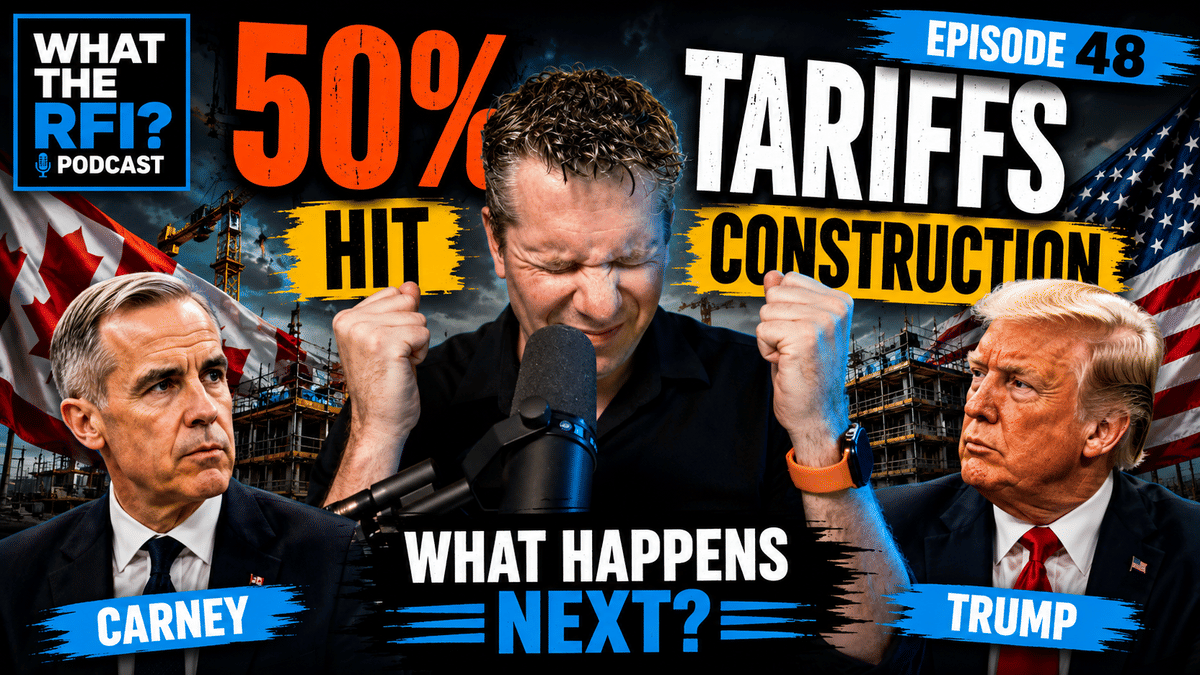
This article was inspired by Episode 48 of What the RFI?, 50% Canada-U.S. Tariffs Hit Construction: What Happens Next? You can listen to the full episode here for the full discussion on pricing, procurement, substitutions and what the latest trade uncertainty could mean for construction projects on both sides of the border.

Occupancy Inspections: What Building Inspectors Look For
Your building is nearly finished. The consultants have signed off. Integrated systems testing is complete. Everyone is talking about move-in day. Now the building inspector is coming. In Episode 50 of What the RFI?, we’re talking about one of the biggest milestones in Construction Administration: the occupancy inspection. What happens when the Authority Having Jurisdiction (AHJ) arrives on site? What is the building inspector actually looking for? Who should attend the inspection? And what ha...
CAN/ULC-S1001 Integrated Systems Testing — Getting Ready for Occupancy
What happens after the fire alarm goes off? Does the elevator recall? Do the doors release? Do the mechanical systems respond? Does the monitoring station receive the signal? In Episode 49 of What the RFI?, we continue our four-part Building Occupancy Series with a practical look at CAN/ULC-S1001 Integrated Systems Testing from the Construction Administrator’s perspective. We break down what S1001 testing is, how it differs from fire alarm verification, who needs to be involved, how to prepar...
50% Canada-U.S. Tariffs Hit Construction: What Happens Next?
Canada-U.S. tariffs are hitting construction, raising new questions about material costs, steel prices, procurement, contracts, and who ultimately pays when prices suddenly change. With new 50% U.S. tariffs affecting billions of dollars of Canadian goods and Canada preparing retaliatory measures, construction materials including steel, aluminum, lumber, cement, plywood, paint, and other building products are caught in the middle. In Episode 48 of What the RFI?, Matt Brennan looks beyond the p...