


Construction Administration Career: How to Get Started in CA
You can spend years producing construction documents and still have a moment on site where you look at something being built and think, That is not how I pictured it.
That moment is one of the reasons a construction administration career can make you a much stronger architect, technologist or project professional. CA forces you to connect what was drawn in the office with what someone actually has to build in the field.
But how do you get started?
There isn’t one prescribed path into Construction Administration. You might be an architectural technologist, intern architect, project coordinator, project architect or project manager. You may already be helping with RFIs and shop drawings without realizing that you’re halfway through the door.
The transition isn’t about throwing away your existing experience and starting over. It’s about taking what you already know and learning how to apply it when the drawings meet the construction site.
Your Technical Experience Is More Valuable Than You Think
If you’ve spent years working on construction documents, you’re not starting from zero.
Think about everything you already deal with: drawings, specifications, detailing, building systems, codes, consultant coordination, wall assemblies, door hardware and all the other pieces that go into documenting a building. That technical foundation becomes incredibly valuable during Construction Administration.
The difference is that now somebody has to build it.
That’s where things get interesting.
A detail can look absolutely perfect on a drawing. Then you arrive on site and discover a pipe running through the space. The opening isn’t the size you expected. The structure doesn’t quite coordinate. The contractor interpreted the detail differently. Suddenly, the pristine little detail you spent hours developing has entered the real world.
And the real world doesn’t care how pretty your Revit detail was.
That ability to understand the drawings and then adapt when actual construction conditions don’t perfectly match them is a major part of becoming good at CA.
Building Something Changes the Way You Draw It
I learned this lesson on a millwork project at home.
I love building things, so naturally I’ve accumulated table saws, chop saws, miter saws and enough other tools to justify almost any trip to the hardware store. There’s always an excuse for another tool.
I designed a piece of millwork for my house, drew the details and then went to build it myself.
That’s when I discovered the idiot who drew it had forgotten some dimensions.
Unfortunately, the idiot was me.
I’d be standing there trying to build something and realize I couldn’t get the information I needed from my own drawings. I’d go back to the computer, add dimensions, print another 11x17 sheet and head back to the project.
That experience changed the way I looked at drawings.
The same thing happens when you spend time in Construction Administration. You start understanding what information the person building the work actually needs. You notice dimensions differently. You think about sequencing differently. You see coordination issues earlier.
It develops what I think of as a construction “mind’s eye.”
You stop seeing only lines on a sheet and start visualizing how somebody is going to put those pieces together.
Document Support Is Already Construction Administration Experience
If you’ve been helping with RFIs, submittals, shop drawings or Supplemental Instructions, don’t discount that experience.
You’re already learning how information moves between the contractor, architect, consultants and owner. You’re learning how questions get raised, how design information gets clarified and how decisions become part of the project record.
Those are fundamental CA skills.
For someone new to the terminology, the What the RFI? Construction Administration 101 guide covers the basic documents and processes, and the broader What Is Construction Administration? guide explains how those pieces fit together during construction.
The next step is moving from supporting the process to owning parts of the process.
That doesn’t need to happen overnight.
Start Small Before Someone Hands You a $100 Million Project
Your first CA assignment does not need to be a $100 million school with 500 RFIs.
Although sometimes that’s exactly how it happens.
If you have the opportunity, start with something manageable. A tenant improvement, smaller renovation or a project where an experienced CA can work alongside you gives you room to learn without being buried by volume.
Start taking ownership of individual pieces. Review an RFI. Help with a shop drawing. Draft an instruction. Attend the site meeting. Participate in a field observation. Help track deficiencies.
Then take on more.
For U.S. architects working toward licensure, this progression lines up well with NCARB’s Construction & Evaluation experience area. NCARB specifically identifies construction-phase documentation, shop drawing and submittal review, RFI responses, field reports, payment applications and project closeout among the experience architects should develop. (NCARB)
The terminology and exact professional obligations vary by jurisdiction and contract, but the underlying lesson travels well: you learn CA by participating in CA.
Want a Construction Administration Career? Tell Someone
This sounds ridiculously simple, but if you’re working at an architecture firm and want more CA experience, tell somebody.
Talk to your project manager. Talk to the project architect. Talk to whoever leads Construction Administration in your office.
Say:
“I want more CA experience.”
Then get more specific.
Ask whether you can attend the next site meeting. Ask whether you can join the next field review. Volunteer to review a shop drawing for a detail you worked on. Ask to draft an RFI response or Supplemental Instruction and have an experienced CA review it with you.
If you’re an intern architect, this is particularly valuable. NCARB recognizes Construction & Evaluation as one of the core experience areas for U.S. licensure candidates and recommends working with supervisors to identify opportunities for field observations when site experience is difficult to obtain early in a career. (NCARB)
Don’t wait for somebody to magically decide you’re ready.
Ask to get involved.
Get Out of the Office and Onto the Construction Site
One of the fastest ways to improve your understanding of construction is also the most obvious:
Get out to site.
Bring the drawings with you.
Walk through the building and compare what’s happening in front of you with what’s shown in the documents. Look at a framed room and pull up the details. Look for backing. Look at wall intersections. Find the mechanical services. Look at the door openings. Ask yourself what gets installed next.
Then start asking questions.
Why was that built this way? What happens if this dimension changes? How is the trade going to install that component? What information was missing? Why did the contractor interpret the detail that way?
Site experience bridges the gap between drawings, specifications and actual construction.
NCARB makes essentially the same point in its guidance for emerging U.S. architects: Construction & Evaluation includes job-site experience, interaction with contractors and evaluating construction against the contract documents and design intent. It even allows certain candidates to earn qualifying experience through site visits with a mentor. (NCARB)
The more construction you see, the better you become at anticipating how your drawings will actually be used.
Learn What the CA Documents Actually Do
Knowing what an RFI or Supplemental Instruction is isn’t enough.
You need to understand why you’re using it.
An RFI is not simply another PDF in the project management system. A construction RFI is a formal communication used to clarify questions about the contract documents or project conditions. You can explore that process further in What Is an RFI in Construction?.
The same principle applies to shop drawings, submittals, changes and field reports.
Don’t think:
“I need to send something to the contractor, so I’ll issue an SI.”
Think:
“What exactly am I communicating?”
What changed? Why? What documents are affected? Who needs to coordinate it? Could there be a cost impact? Could there be a schedule impact? What does the contractor actually need in order to proceed?
AIA’s current Construction Contract Administration education similarly identifies communication, submittals, RFIs, modifications and site visits as fundamental parts of construction-phase practice. (The American Institute of Architects)
Good CA isn’t about producing paperwork.
It’s about communicating decisions clearly enough that people can build from them.
Communication Might Be the Most Important CA Skill
You can know the drawings inside out and still struggle in Construction Administration if you can’t communicate.
CA puts you in the middle of a lot of conversations. You’re dealing with architects, engineers, owners, general contractors, subcontractors, suppliers, inspectors and sometimes lawyers. They all approach the project from different perspectives.
And occasionally everybody wants an answer immediately.
Learning how to communicate clearly, calmly and professionally matters just as much as knowing the technical answer.
That includes written communication. If you issue a construction document, the person receiving it should understand what you’re asking them to do. A vague cover page with three drawings attached and no explanation isn’t communication. It’s a scavenger hunt.
It also includes meetings. Learning how to organize information, identify decisions and assign responsibility is part of becoming an effective CA. The guide to running construction site meetings and taking better meeting notes is a useful next step if meetings are an area where you haven’t had much experience yet.
You Don’t Need to Know Everything
This may be one of the biggest misconceptions about moving into CA.
You do not need to know every answer.
I certainly don’t.
I’ve been doing this for years and I’m still asking questions. I’ll talk to architects, consultants, contractors and other CA professionals when something comes up that I haven’t dealt with before.
That’s normal.
You’re not a mechanical engineer, electrical engineer, structural engineer and building envelope consultant rolled into one person. Your job is not to magically know everything about every building system.
The skill is knowing how to find the answer.
Sometimes the best response you can give is:
“I don’t know. Let me check.”
Then check.
Curiosity is one of the best characteristics you can bring into a Construction Administration career. Ask why. Ask how. Learn from the trades. Learn from your consultants. Learn from experienced contractors.
And find a mentor.
Find Someone You Can Ask the Dumb Questions
A good CA mentor is incredibly valuable.
You need somebody you can call and say, “I’ve got a situation. What do you think?”
I’ve had those conversations throughout my career, and I still have them. Experience doesn’t eliminate questions. It gives you better questions to ask.
A mentor can help you understand not just what they would do, but why. That’s where a five-minute conversation can teach you something you’ll use for the next 20 years.
Your mentor doesn’t necessarily need to sit beside you every day either. Build relationships with people you respect throughout the industry. Architects, senior CAs, consultants and experienced contractors can all teach you different things.
Construction is too complicated to learn from one person.
Understand What You’re Agreeing to Before Taking a CA Role
Moving into a formal Construction Administration position is exciting, but you should understand what the firm actually expects from you.
Are you assisting an experienced CA or taking full responsibility for the project? How many projects will you carry? Are you expected to continue producing design or construction documents at the same time? What authority will you have? Who reviews difficult decisions with you? What support is available from the project architect and consultants?
Those conversations matter.
If you’re being asked to take on significantly different responsibilities, discuss the role with your employer rather than assuming everyone has the same expectations. And if an employment agreement contains language that genuinely concerns you, have it properly reviewed rather than relying on general industry advice.
The specific contractual role of an architect during construction also depends on the owner-architect agreement, construction contract and jurisdiction. For example, AIA notes that the architect’s construction-phase services are defined by the applicable agreements and can vary by project. (The American Institute of Architects)
Know the role you’re accepting before you own it.
Construction Administration Will Make You a Better Designer
One of the best things about CA is seeing the building come alive.
You solve problems. You work with incredibly knowledgeable people. You see details that existed on your screen become walls, stairs, doors and entire buildings.
You also see your mistakes.
Those lessons tend to stick.
I’ve made mistakes in details that I never made again because I had to deal with the consequences during construction. A problem on site has a remarkable ability to burn a detail into your memory.
That feedback loop makes you better.
You start preparing drawings differently because you’ve seen how contractors use them. You coordinate things differently because you’ve watched trades try to install them. You add dimensions because you’ve personally stood there wondering why the idiot who drew the detail didn’t include one.
Again, sometimes that idiot is you.
That’s okay.
Learn from it.
And Learn How to Turn CA Off
There’s one final career lesson that doesn’t get talked about enough.
Take your damn vacation.
Construction Administration can consume you if you allow it. There is always another email, another RFI, another submittal, another pricing question and another contractor who needs an answer right now.
If you’re not careful, you never really leave the project.
When I go on vacation, I’ve learned that an out-of-office message isn’t enough. If I can see my email, I’ll check it. Then I’ll see one RFI that looks easy to answer. Forty-five minutes later I’m looking at drawings, irritated about a request for extra and mentally back at work.
So I remove work email from my phone.
Calendar too.
Before leaving, deal with the critical items you can, prepare a handover for your team, tell the appropriate people you’re away and then get the hell out of there.
Your projects will survive.
The RFIs will still be waiting when you return.
They’ll probably have friends.
A Construction Administration Career Starts by Getting Involved
If you’re interested in CA, don’t wait until you feel like you know enough.
Get involved.
Ask to attend the site meeting. Go on the field review. Take an RFI. Review the shop drawing. Draft the instruction. Walk the building with your drawings open. Ask the contractor why something is being built a particular way. Find a mentor and ask questions.
You don’t need to know everything before you start.
None of us did.
The important part is making the transition from looking at construction through the drawings to understanding how those drawings become a building.
And once you’ve experienced that connection, you’ll probably never look at your drawings the same way again.
This article was inspired by Episode 51 of What the RFI?, recorded from Mackenzie Beach in Tofino after a listener asked how to make the transition into Construction Administration. Listen to the full episode for the conversation, stories and probably a little more beach in the background.

Fan Mail: How to Get Into Construction Administration
How do you get into Construction Administration? In this special episode of What the RFI?, recorded while on vacation in Tofino, BC, I answer some fan mail from Richard—an experienced Architectural Technologist looking to make the jump into a full-time Construction Administration role. We talk about how experience in architectural technology, construction documents, RFIs, shop drawings and consultant coordination can become the foundation for a career in CA—and why you probably already know m...
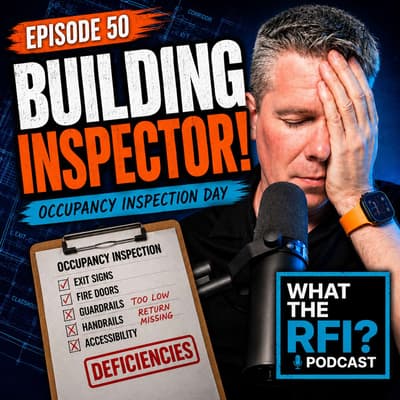
Occupancy Inspections: What Building Inspectors Look For
Your building is nearly finished. The consultants have signed off. Integrated systems testing is complete. Everyone is talking about move-in day. Now the building inspector is coming. In Episode 50 of What the RFI?, we’re talking about one of the biggest milestones in Construction Administration: the occupancy inspection. What happens when the Authority Having Jurisdiction (AHJ) arrives on site? What is the building inspector actually looking for? Who should attend the inspection? And what ha...
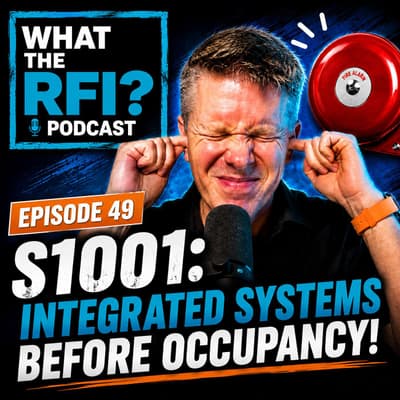
CAN/ULC-S1001 Integrated Systems Testing — Getting Ready for Occupancy
What happens after the fire alarm goes off? Does the elevator recall? Do the doors release? Do the mechanical systems respond? Does the monitoring station receive the signal? In Episode 49 of What the RFI?, we continue our four-part Building Occupancy Series with a practical look at CAN/ULC-S1001 Integrated Systems Testing from the Construction Administrator’s perspective. We break down what S1001 testing is, how it differs from fire alarm verification, who needs to be involved, how to prepar...